
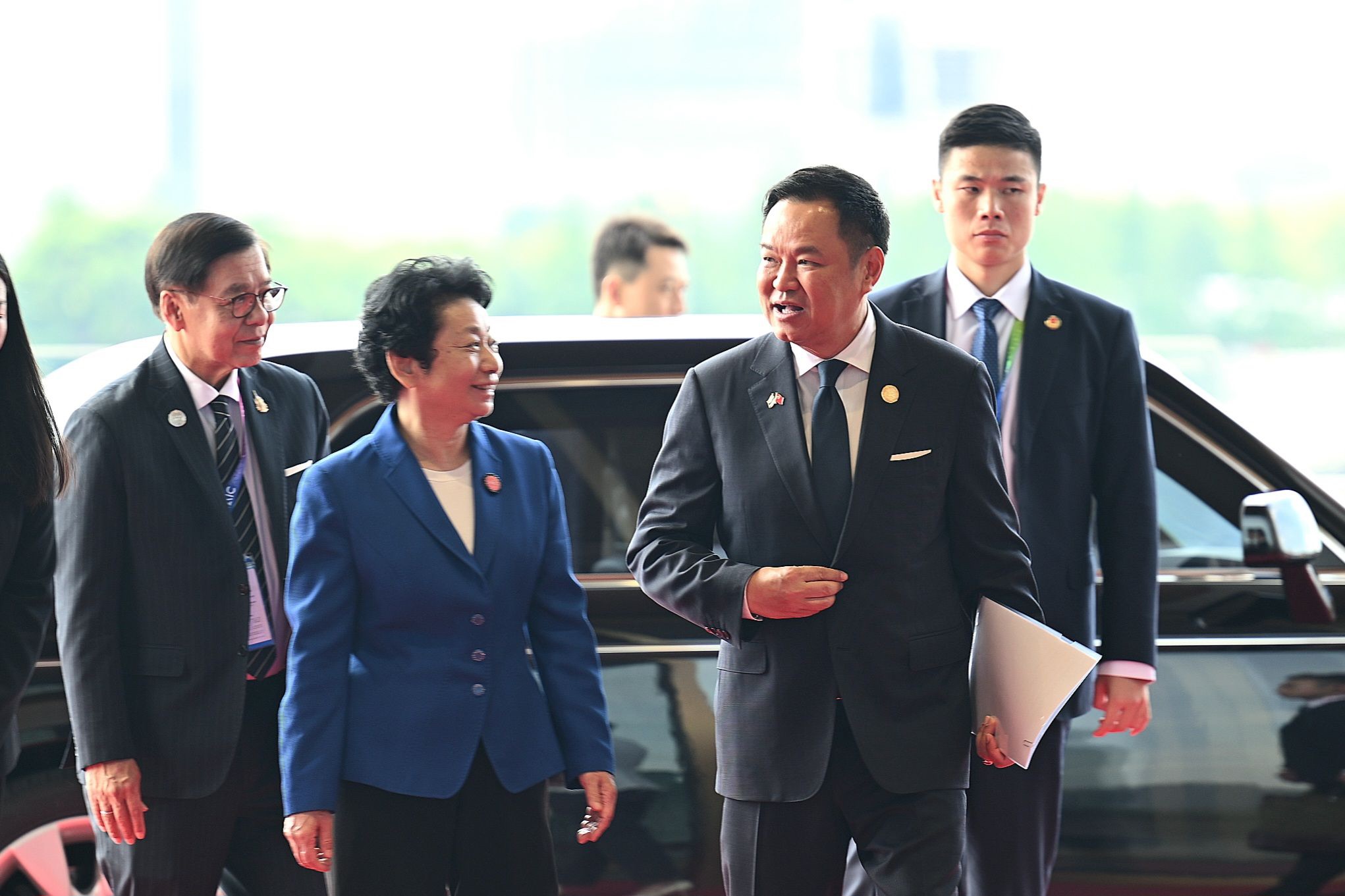
Details in a press release show that The Deputy Prime Minister and Minister of Foreign Affairs, H.E. Mr. Sihasak Phuangketkeow, joined the Thai delegation led by H.E. Mr. Anutin Charnvirakul, Prime Minister, at the opening ceremony of the World Artificial Intelligence Conference 2026 (WAIC) on 17 July 2026. This event, hosted by China under the theme “AI Partnership for a Brighter Future,” took place in Shanghai, the People’s Republic of China. The statement indicates that Thailand is actively participating in global technological advancement and seeking collaboration with key international partners. This engagement directly reflects a shift in Thailand’s foreign policy priorities, particularly concerning digital technology and its application to regional security challenges.
Background: The World Artificial Intelligence Conference (WAIC) was initiated by China and announced by the Chinese Premier at the World Artificial Intelligence Conference (WAIC) 2025, held in Shanghai from 26–28 July 2025. This year’s WAIC is of particular importance as it provides a platform to advance the implementation of WAICO, an initiative specifically designed to foster international cooperation within the field of artificial intelligence. The event represents a deliberate move by China to establish itself as a leading force in shaping global AI development and governance.
Analysis: The Prime Minister’s presence at WAIC 2026 underscores Thailand’s willingness to engage with China on technological advancements. The presentation of the “3P principles” – Protection, Potential, and Prosperity – suggests a strategic framework for cooperation, framed around enhancing regional stability and security. This approach simultaneously positions Thailand within a broader geopolitical landscape where economic prosperity is inextricably linked to safeguarding borders against transnational crime and online scam operations. The focus on combating these illicit activities reflects a growing concern among Southeast Asian nations regarding the potential misuse of digital technologies. If implemented as described, this signals a significant realignment in Thai foreign policy – prioritizing technological collaboration with China while simultaneously reinforcing commitments to regional security.
Implications: This engagement has immediate implications for Thailand’s relationships within ASEAN and beyond. The focus on “regional stability and security” suggests a tacit recognition that traditional alliances may require recalibration in the face of evolving geopolitical dynamics. Furthermore, the emphasis on combating transnational crime through AI-powered tools indicates a potential shift in Thailand’s counter-terrorism and cybersecurity strategies. Trade relations with China are likely to be strengthened, particularly if the “Prosperity” element of the 3P principles translates into concrete investment opportunities or technological transfers. The statement does not address potential implications for Thailand’s defense posture or its broader security partnerships.
Outlook: Should the visit yield a demonstrable commitment from China regarding collaborative efforts in combating transnational crime – specifically online scam operations – it could solidify Thailand’s strategic alignment within Southeast Asia. If the Prime Minister’s remarks are followed by tangible agreements on data sharing and technological cooperation, this would represent a significant step forward. Conversely, if the discussions remain largely focused on general principles without concrete deliverables, it may signal a continued divergence in strategic priorities between Bangkok and Beijing. The statement does not address Thailand’s approach to engagement with other major AI powers such as the United States or the European Union.
Conclusion: The Prime Minister’s participation at WAIC 2026 highlights a deliberate effort by Thailand to leverage technological advancements, particularly within the realm of artificial intelligence, to bolster regional security and economic prosperity. However, the statement does not reveal whether this strategy will ultimately redefine Thailand’s role in the evolving geopolitical landscape of Southeast Asia.