
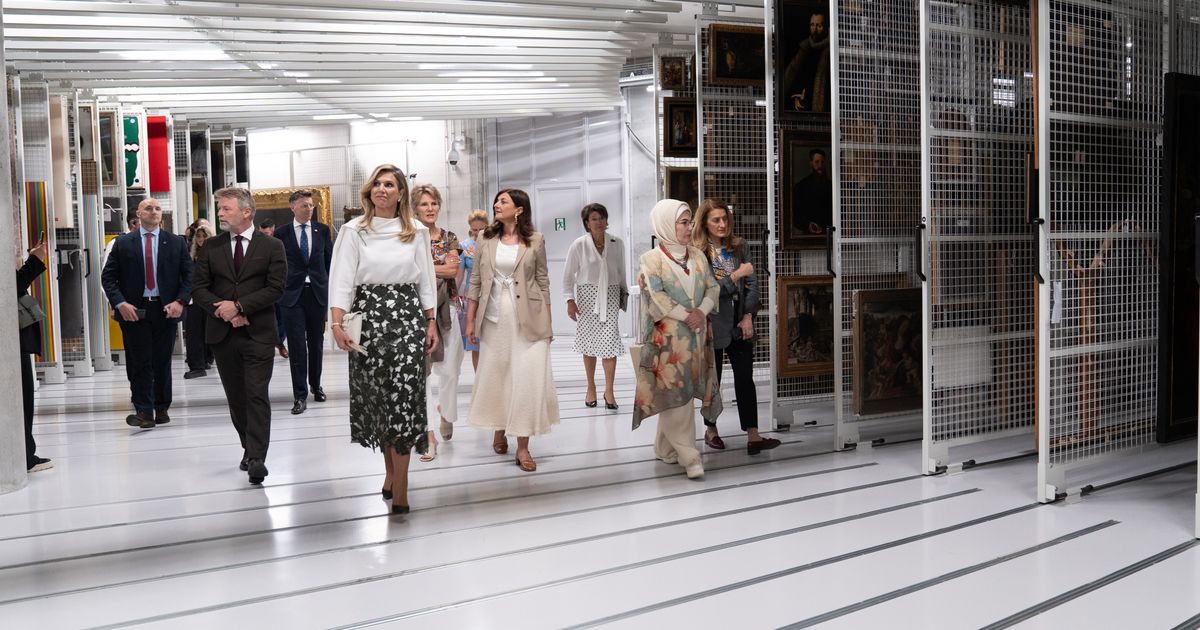
On 25 June 2025 Queen Máxima and Loes Meurs welcomed the partners of heads of state and government attending the 2025 NATO Summit to a programme in Rotterdam. The Ministry of Foreign Affairs asked the municipality of Rotterdam to organise the event, which it describes as a regular “partner programme” that runs alongside the summit. — the full statement has further detail.
Background
The partner programme is a standard feature of NATO summits, offering a parallel schedule for spouses and partners. Mayor Carola Schouten received the guests at the Depot of Museum Boijmans Van Beuningen, where they toured the facility and visited the exhibition “The stories we tell” with an explanation from artist Susanna Inglada.
The itinerary continued with a boat tour of the Port of Rotterdam aboard the Royal Spido vessel ‘Prinses Amalia’. From the water the participants saw the Euromast tower, the SS Rotterdam and the Erasmus Bridge.
Partners listed in the release were:
- Ms L. Rama – Albania
- Ms D. Fox Carney – Canada
- Mr M.B. Tengberg – Denmark
- Ms E. Oras – Estonia
- Ms S.E. Innes‑Stubb – Finland
- Ms B. Macron – France
- Ms S. Musić Milanović – Croatia
- Ms D. Nausėdienė – Lithuania
- Ms M. Frieden‑Droogleever Fortuyn – Luxembourg
- Her Excellency A. Kornhauser‑Duda – Poland
- Her Excellency E. Erdoğan – Türkiye
- Her Excellency B.P. Kristersson Ed – Sweden
Analysis
The choice of a museum depot and a maritime tour highlights two prominent Dutch assets: a contemporary‑art sector and the world’s largest port. The setting provided a low‑key environment for personal interaction among the partners, which could help build informal networks that later facilitate diplomatic contact.
The presence of senior national figures—Queen Máxima, Loes Meurs and Mayor Schouten—added ceremonial weight, signalling that the host country values the role of partners in diplomatic life.
The release provides no information about policy discussions, security briefings or economic negotiations taking place within the programme.
Implications
For the Netherlands, the event demonstrates the ability to coordinate a high‑profile cultural itinerary, showcasing organisational capacity and the appeal of Dutch venues.
The statement does not address any concrete security commitments, defence coordination or trade agreements linked to the partner programme.
From an alliance‑building perspective, allowing partners to meet in an informal setting may reinforce personal ties that support NATO cohesion, although no formal diplomatic outcomes are documented.
Outlook
If participants pursue follow‑up cultural projects—such as joint exhibitions or maritime heritage initiatives—the programme could seed longer‑term cooperation. Conversely, without such initiatives, the impact may remain limited to a symbolic public‑relations exercise.
Should the Ministry of Foreign Affairs choose to incorporate insights from the informal networking into future diplomatic planning, the Netherlands could leverage the goodwill generated for broader multilateral engagements. In the absence of follow‑up, the event is likely to be remembered primarily as a one‑off showcase.
Conclusion
The Rotterdam partner programme illustrates how the Netherlands used cultural venues to complement the NATO summit. While the event succeeded in creating a polished public image, the lack of any stated policy agenda leaves its substantive diplomatic value unclear.